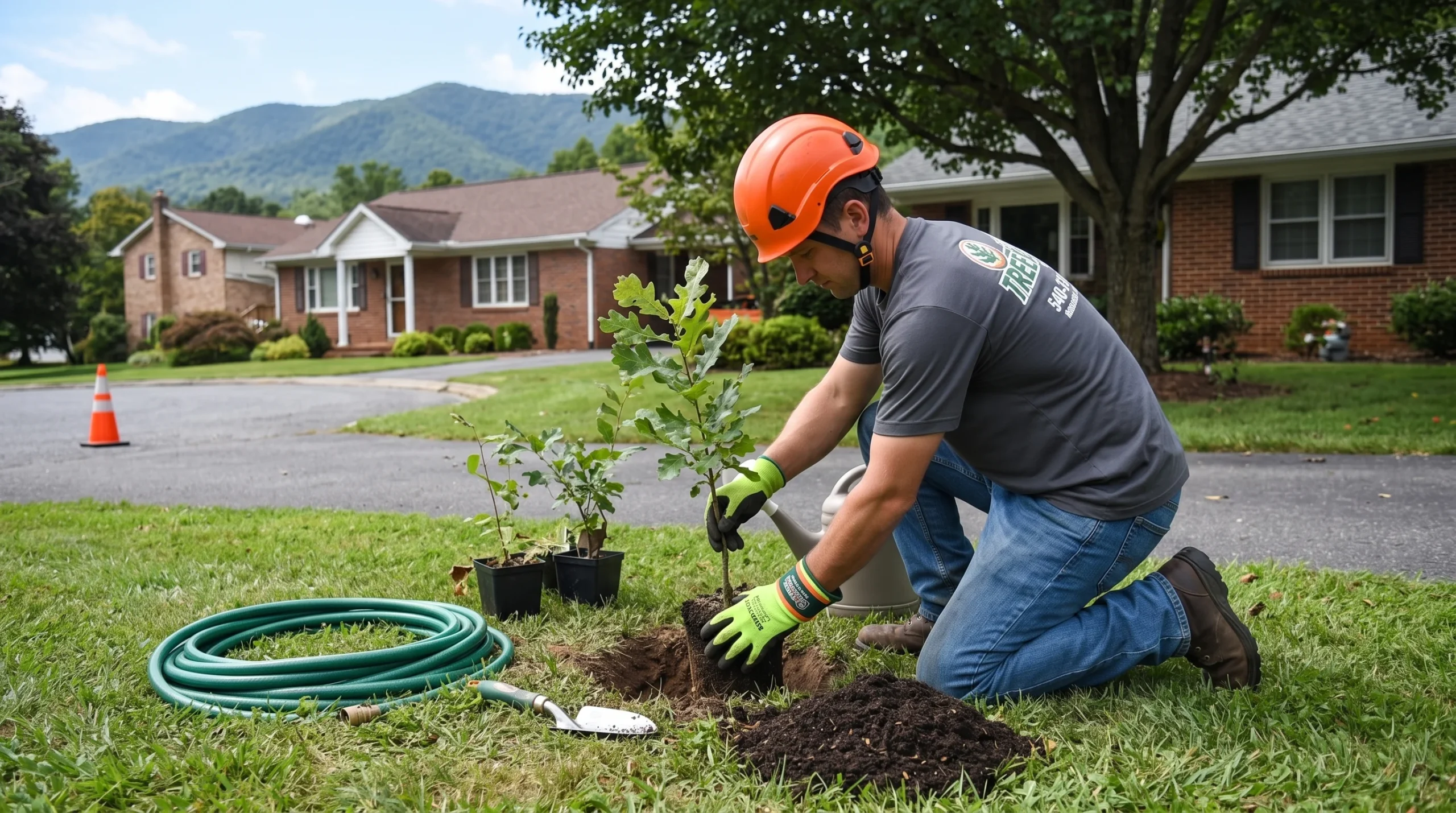
Planting a tree near your home can provide shade, privacy, curb appeal, and seasonal beauty. However, choosing the wrong location can create long-term maintenance problems, including branches rubbing against the roof, roots interfering with paved surfaces, and conflicts with underground utility lines.
So, how far should a tree be from a house? The answer depends on the tree’s mature height and canopy spread, its growth characteristics, the available soil space, and the condition of nearby structures. A small ornamental tree may fit comfortably in a narrow front yard, while a large shade tree needs considerably more room.
For most homeowners, the best approach is to plan for the tree’s full-grown dimensions rather than the size of the sapling at planting. The following guidelines explain how to choose an appropriate distance, reduce potential foundation problems, and select trees that suit your property.
How Far Should a Tree Be From a House?
A useful starting point is to plant small trees approximately 8 to 10 feet from a house, medium-sized trees at least 15 feet away, and large trees at least 20 feet away. These are general landscaping guidelines, not guarantees against damage. Large shade trees may need 30 to 40 feet of clearance, depending on their mature spread and the available planting area.
The Arbor Day Foundation recommends spacing trees according to their expected mature height, with additional clearance around building corners. Purdue Extension also advises allowing enough space for a tree’s full-grown dimensions, noting that larger shade trees may need to be planted as far as 40 feet from a home.
Recommended Tree Planting Distances
The table below summarizes the Arbor Day Foundation’s general recommendations for planting near residential structures.
| Tree Size at Maturity | Recommended Distance from a House Wall | Distance from a House Corner |
|---|---|---|
| Small tree, up to 25 feet tall | 8 to 10 feet | 6 to 8 feet |
| Medium tree, up to 40 feet tall | At least 15 feet | At least 12 feet |
| Large tree, over 40 feet tall | At least 20 feet | At least 15 feet |
Source: Arbor Day Foundation, Planting the Right Tree in the Right Place.
These measurements are practical starting points. A tree with a particularly wide canopy, substantial surface roots, or a planting site with limited soil volume may require more room. Local climate, soil conditions, building design, and utility locations should also influence the final decision.
Why Tree Planting Distance Matters
Correct tree placement helps protect both the structure and the tree itself. Trees need adequate space for their roots and branches to develop without constant interference from buildings, pavement, and other obstacles.
1. Protecting Your Home’s Foundation
One common concern about trees near foundations is whether roots can crack or damage concrete. The answer requires some context.
Tree roots generally follow paths where soil, moisture, and oxygen are available. When they encounter a solid foundation, they typically grow around or over the obstruction rather than drilling through intact concrete. However, roots can exploit existing cracks or openings, and growth near vulnerable structures can contribute to problems under certain conditions.
Roots may also grow into leaking water or sewer pipes through existing openings. This is why a tree’s distance from underground plumbing matters alongside its distance from the house itself.
The risk varies with root growth, soil conditions, drainage, the foundation’s condition, and the location of existing leaks. Simply finding a tree near a foundation does not establish that the tree has caused structural damage.
2. Preventing Roof and Siding Damage
Branches can eventually extend over a roof, scrape siding, block gutters, or interfere with windows. Wind can move branches against a building, while falling limbs may damage shingles, vehicles, or other property.
Allowing adequate clearance when planting reduces the need for repeated pruning as the tree grows. Homeowners should consider the mature canopy width, not just the expected height, when selecting a planting location.
3. Reducing Problems With Driveways and Walkways
Some trees develop prominent surface roots that can lift or disrupt nearby pavement. This can create uneven walking surfaces and increase maintenance needs.
The risk depends on the species, soil conditions, pavement construction, and available space for root growth. Where a driveway or walkway is close to the proposed planting location, selecting a smaller tree or moving the planting site farther away can help reduce conflicts.
How Tree Roots Grow Near a House
Understanding root growth makes it easier to evaluate the safe distance to plant trees from a house.
Most tree roots are relatively shallow. According to the University of California’s Integrated Pest Management Program, many roots grow within the upper two feet of soil, while lateral roots of established trees can extend well beyond the canopy’s drip line.
Roots do not necessarily mirror the shape of the branches above them. Their direction and spread depend on the availability of moisture, oxygen, nutrients, and suitable soil.
This has three practical implications:
-
- Root spread can exceed canopy spread. A tree that appears to fit above ground may need more underground space than expected.
-
- Leaking pipes can attract roots. Existing cracks and leaks provide access to moisture, making pipe maintenance an important part of preventing root-related problems.
-
- Restricted soil can affect growth. Foundations, compacted ground, pavement, and other barriers can change the way roots develop.
These factors explain why planting distance should be considered alongside the tree species, site conditions, and location of underground infrastructure.
What Is the Best Tree Planting Distance From a House for Different Trees?
The best spacing depends on the tree’s mature dimensions and growth habits. Common landscape categories can help homeowners narrow their options, but the final distance should be based on the selected species and cultivar.
Small Ornamental Trees
Small trees, such as certain dogwoods, redbuds, and Japanese maples, may suit smaller residential yards. Many varieties have a more manageable mature size than large shade trees.
A distance of 8 to 10 feet from a house wall can be a reasonable starting point for suitable small trees. However, check the mature canopy width and confirm that the selected variety fits the available space.
Medium-Sized Trees
Medium-sized trees can provide meaningful shade and visual privacy without reaching the dimensions of some large shade trees. They still need room for their crowns and roots to develop.
A starting distance of at least 15 feet from a house wall is consistent with the Arbor Day Foundation’s guidance for trees reaching up to 40 feet tall. Trees with wider crowns or site-specific restrictions may need additional clearance.
Large Shade Trees
Large trees can be valuable additions to spacious properties, but they need careful placement. Their mature canopies can extend over buildings, while their extensive root systems may encounter pavement, utility lines, and other structures.
For trees expected to exceed 40 feet in height, start with at least 20 feet from a house wall. Some large shade trees may require 30 to 40 feet, particularly when their mature canopy is broad.
Before planting, confirm the species’ mature height and spread using a reliable nursery or extension resource. Do not assume that every tree within the same general category requires identical spacing.
How to Choose the Right Trees for Planting Near a House
If you are deciding on the best trees to plant near a house, consider more than appearance. A suitable choice should match your climate, available space, soil conditions, and maintenance preferences.
Check mature size first. Look up both the expected height and crown spread. These measurements provide a more useful basis for spacing than the size of the tree in its nursery container.
Choose a species suited to your region. Native and locally adapted trees can be good candidates when they match the site’s growing conditions. Confirm that the selected species will tolerate your area’s temperature range, rainfall, and soil type.
Consider the planting site’s drainage. Soil moisture and drainage influence root growth and tree health. Avoid assuming that the same spacing recommendation will work equally well in every soil type.
Locate underground utilities before digging. In the United States, call 811 before excavation so underground utility lines can be marked. Also identify private irrigation lines and other infrastructure that may not be included in public utility locating services.
Plan for future maintenance. Think about roof access, gutter cleaning, pruning, lawn maintenance, and the space needed to inspect the foundation. A tree that fits the yard today should remain manageable as it matures.
What If a Tree Is Already Growing Close to Your House?
An established tree growing near a house does not automatically need to be removed. Its condition, species, size, root location, and proximity to the structure all matter.
Look for branches contacting the building, visible pavement lifting, exposed roots, or recurring plumbing problems. New or widening foundation cracks and doors or windows that suddenly become difficult to operate deserve attention, although these symptoms can have causes unrelated to trees.
If you suspect root-related damage, have the situation evaluated rather than cutting large roots or removing the tree without an assessment. Major root cutting can affect tree stability and health, especially when roots close to the trunk are involved.
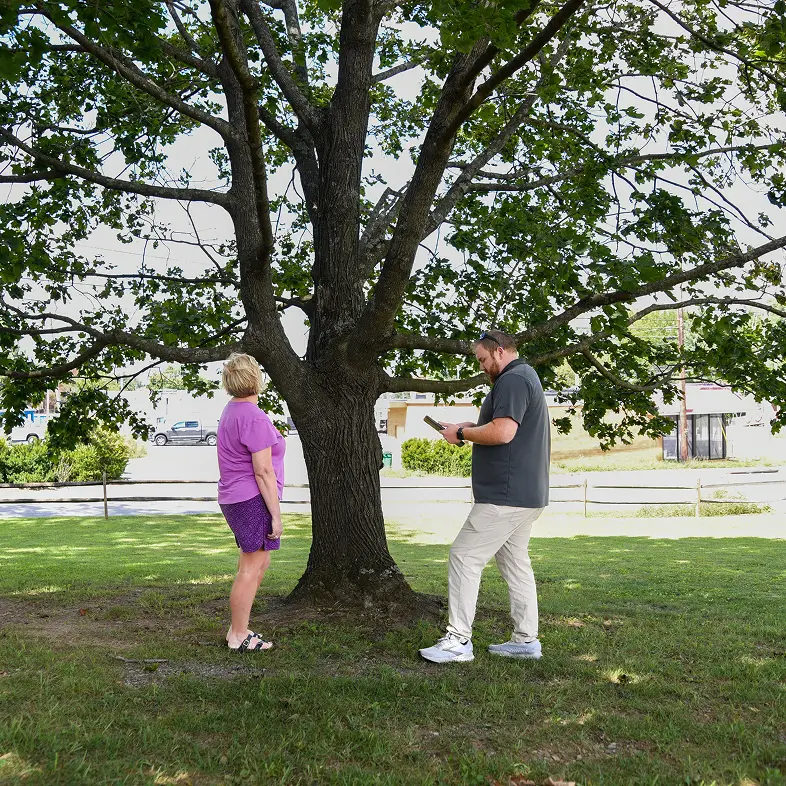
A qualified arborist can assess the tree and advise whether pruning, monitoring, root management, or removal is appropriate. If foundation movement or structural damage is suspected, consult a qualified foundation professional as well. Tree management and structural assessment address different parts of the problem.
Frequently Asked Questions
Can tree roots damage a house foundation?
They can contribute to damage in some circumstances, particularly when roots exploit existing cracks or openings. Roots may also affect leaking underground pipes. However, proximity alone does not prove that roots have damaged a foundation.
Is 10 feet enough space between a tree and a house?
Ten feet may be suitable for certain small trees, depending on their mature canopy and root characteristics. It is generally not enough to use as a universal spacing rule for medium or large trees.
Should trees be planted farther from a house than their roots are expected to spread?
Roots often extend beyond the canopy, so root spread alone is not a reliable way to determine the planting distance. Consider mature canopy width, root behavior, soil conditions, utility locations, and the type of structure nearby.
What should I do before planting a tree near my foundation?
Identify the tree species, check its mature dimensions, measure the available space, locate underground utilities, and review the site’s drainage and soil conditions. If the planting location is particularly restricted or the foundation already has damage, seek professional advice before proceeding.
Make a Better Tree-Planting Decision With All Natural Tree Experts
Choosing the right tree and planting it at the right distance can help prevent avoidable maintenance issues while allowing the tree to grow in a suitable location. The most useful starting point is to evaluate mature tree size, available root space, underground utilities, and the condition of nearby structures before digging.
If you are concerned about trees growing close to your home or need guidance on managing existing trees, All Natural Tree Experts can be a starting point for exploring professional tree care options. Visit the company’s website to learn more about its services and determine whether its offerings suit your property’s needs.
A well-planned landscape begins with informed decisions. Give your trees enough room to thrive, and consider professional guidance when the right planting distance or the condition of an existing tree is uncertain.
Choose the solution based on your property’s needs, not simply on the name of the service.
Schedule Your Free Consultation
 Call us: (540) 634-6572
 Email: sales@allnaturaltreeexperts.com
Our Locations
 Christiansburg
114 Pepper St SE Suite A, Christiansburg, VA 24073
Roanoke
3154 Brandon Ave SW, Roanoke, VA 24018
Charlottesville
310 Avon St #2, Charlottesville, VA 22902